
As fuel continues to drain your wallet, you’ve finally decided to go electric. Or maybe you’re upgrading your setup because your current battery for electric outboards just doesn’t cut it anymore. Either way, you’re not alone.
The battery pack is the heart of your entire electric outboard system. Get it right, and your days on the water will be smooth, quiet, and worry-free. Get it wrong, and you’ll spend more time charging (or troubleshooting) than cruising. It becomes an important factor when choosing an electric outboard. In this guide, we will explain all your confusion when picking the right electric outboard battery for your boat.
You might think a battery is just a box full of cells. But in the world of marine propulsion, it’s the difference between gliding easily across the bay and limping back to shore at half throttle.
You’ve probably seen all sorts of battery acronyms thrown around, and it can feel like alphabet soup. Don’t worry. Let’s sort it by chemistry. Generally speaking, these batteries can fall into the categories of flooded batteries, gel batteries, AGM batteries (advanced lead-acid batteries), and lithium batteries.
The old faithful. Affordable, familiar, and easy to source. But they’re heavy, need upright installation, and require ventilation and periodic maintenance. For propulsion, they’ll get you moving—but the weight and lower usable depth of discharge mean you’ll lose range fast.
A step up in stability. Gelled electrolyte resists spillage and tolerates deeper discharge than flooded cells. Still, they charge slowly and remain relatively heavy for the energy you get.
AGM tightens everything up: sealed, lower internal resistance, better current delivery, and typically longer life than basic flooded. Many DIY boaters like AGM for simplicity and robustness. But weight and volumetric efficiency are still worrying. You’ll often shave runtime compared with lithium at the same footprint, and your bow or stern trim can suffer.
Now we’re talking propulsion-grade energy. Lithium chemistries offer higher energy density, flatter voltage under load, and thousands of cycles when treated well. Inside this family, LFP (LiFePO4), LTO (Lithium Titanate) and NMC (Nickel Manganese Cobalt) dominate marine use.
Among them, NMC is the performance favourite. It boasts higher energy density and strong power delivery. This means you can either carry more range in the same space or shave weight to help your hull pop onto plane sooner. If you’re chasing responsive throttle, longer legs, or you simply don’t want a battery to sink your small boat’s handling with unnecessary mass, NMC is often the sweet spot for a powerful electric boat engine.
Imagine flooring your throttle and the motor barely responding. That’s what happens when your pack can’t deliver enough surge current. The right battery keeps your electric outboard system running in its sweet spot. It helps ensure smooth torque, instant throttle, and minimal heat during your voyage.
Pick too small a battery and you’ll be stuck looking nervously at your remaining charge instead of the horizon. Oversize it, and you’ll pay for excess weight you don’t need. When done right, your setup lets you cruise at 70% power for hours, with reserve energy left to dodge a squall or explore a hidden cove.
A good pack isn’t cheap, but a poor one is more expensive. The right choice saves money over time through longer life cycles, less maintenance, and fewer energy losses.
Safety isn’t glamorous—but it’s everything. You will never want an outboard motor battery to sink your small boat because it wasn’t secured or protected from spray. With proper insulation, the battery can keep your electric outboard quiet.
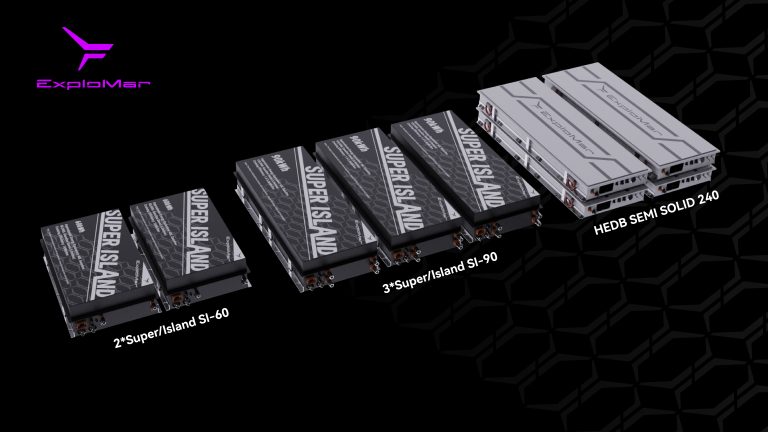
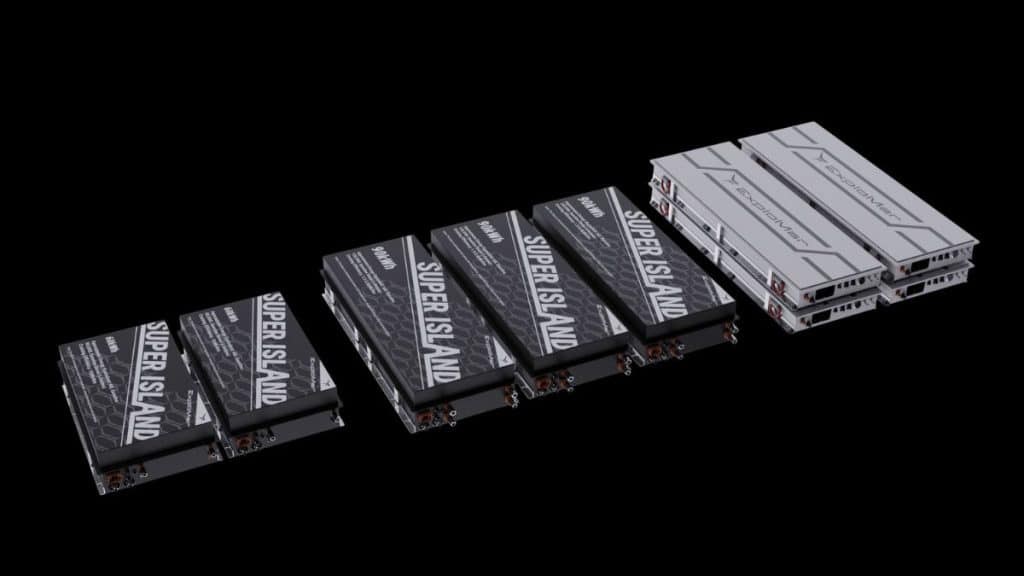
If you’re aiming for serious range and lively throttle, ExploMar’s battery will be a surprise. Our high-energy NMC battery offers high energy density, long cycle life, and enhanced safety against overheating. We have developed two professional series on electric outboard motor batteries: the Super/Island (SI) and HEDB.
The SI series is designed for commercial and leisure boats. It gives you modular building blocks so you can right-size capacity and voltage for your electric outboard system without wrecking trim or chewing up space.
The Super/Island series includes two platform options:
The HEDB battery targets high-performance vessels and cold-weather operations. It is a semi-solid-state solution with 240 kWh capacity, and weighs only 30% of a traditional LFP battery. It is exactly the kind of pack that lets you “get away with a smaller battery” for the same mission profile, or keep the same footprint and go notably farther.
The two series boast several advantages. The denser the battery, the more range you get per kilogram. ExploMar’s modules deliver strong voltage stability even under surge loads, meaning your electric outboard engine doesn’t sag when you punch the throttle. At Monaco Energy Boat Challenge, a 6.3 m carbon RIB equipped with an ExploMar WAVE 300 motor—equipped with a 125kwh high-energy battery—maintained an average speed of around 33 knots during competition. It wins the game with roughly 40% capacity remaining. That’s a real-world example of how high-density chemistry translates into longer endurance and fewer charging breaks, even under demanding performance conditions.
Each ExploMar battery unit is sealed to IP67 standards, that means no nasty surprises when you take a pounding from waves or a salt-spray drenching. Inside, high-current bus connections handle up to 2C discharge rates without strain, and the Battery Management System (BMS) keeps watch on every cell around the clock. If something goes wrong, the BMS isolates the fault before it can spread, protecting your system long before you even notice the alert.
Whether you’re a weekend cruiser or a full-time skipper, efficiency is what keeps your trips carefree and your wallet happy. ExploMar’s electric outboard system runs at up to 95% efficiency—a huge leap from the roughly 15% you get from traditional fuel engines. That means more distance per charge, less wasted energy, and serious savings over time.
To put it in perspective, an SI-60 pack can save around 120,000 litres of petrol across its lifespan, while an SI-90 can save up to 180,000 litres. Stack a few together, and you’re not just cutting costs—you’re slashing emissions too. Even a modest 10% bump in efficiency can be the difference between docking comfortably at sunset or trickle-charging under the pier lights at midnight.
ExploMar’s SI series batteries come in a standardised size of 710 mm in width and 300 mm in height, ensuring uniform installation and offering great flexibility to fit various types of boats. You can easily adjust the battery layout to accommodate different hull shapes and centre-of-gravity requirements, helping your boat achieve better balance and operate more efficiently.
Not all waters are friendly. If you’re boating in tropical humidity or winter frost, temperature management becomes critical. ExploMar integrates liquid-cooling and heat-exchange loops designed for marine duty—not the generic air-cooling. In practice, that means your pack won’t overheat when you’re charging under the summer sun or lose range in 5°C water.
Ready to spec your setup? Here’s the fun part—turning all that theory into something that works on your own boat. Let’s walk through it step by step.
Start simple: how long do you want to stay out, and at what speed? Multiply your motor’s average power draw by the number of hours you plan to cruise, then add 20–30% buffer for wind, tide, and detours. If you rarely go full throttle, you might trim that down—but don’t skimp on safety reserve.
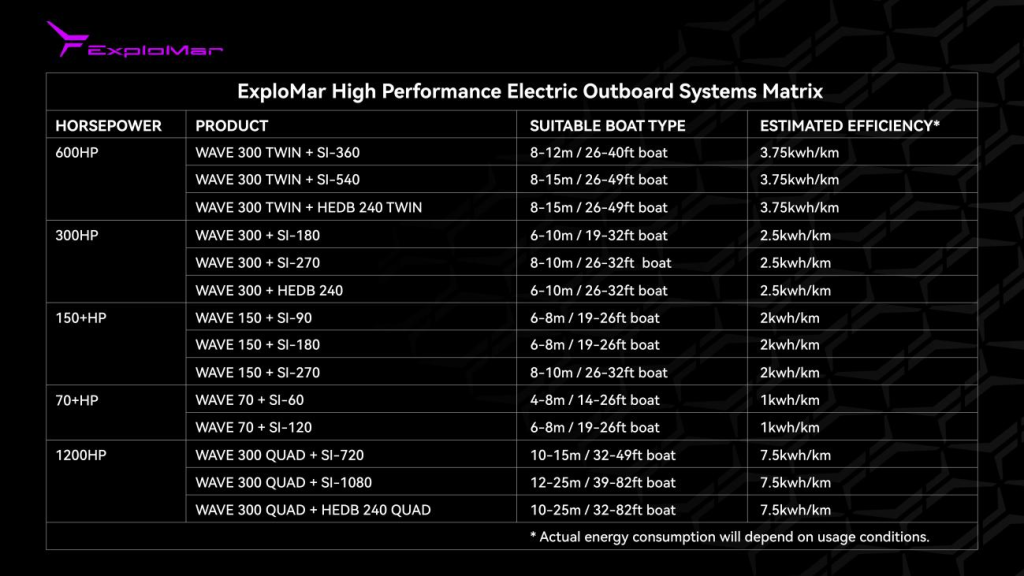
If your boat falls in the 4–6 metre range, the ideal setup is the WAVE70 motor paired with a single SI-60 battery. That combination comfortably covers about 60–80 kilometres on a charge. Want more range? Simply add a second pack to bring total capacity to 120 kWh, doubling your cruising distance to roughly 120–160 kilometres.
For medium-sized boats (6–8 metres), the WAVE150 motor with an SI-90 battery hits a sweet balance between power and endurance, giving around 60–80 kilometres per charge. Step up to two SI-90s (the SI-180 configuration), and you can cruise 120–150 kilometres. Need serious stamina? Three SI-90 modules (SI-270) will push you out to about 150–250 kilometres.
Running something larger—say an 8–10 metre craft? Pair the WAVE300 with an SI-180 for mid-range trips, or upgrade to an SI-270 when longer passages or higher speeds are on the cards. For owners seeking a lighter, premium configuration, the HEDB240 semi-solid battery offers exceptional energy density, safety and stability in demanding marine environments—perfect for performance vessels and specialised duty boats.
And if you’re chasing more power altogether, ExploMar systems can run dual- or quad-motor configurations with multiple battery banks. From heavy-duty transport to long-range cruising and mission-specific operations, there’s always a tailored solution to match your vessel’s needs.
Don’t overpack energy “just in case”. More capacity equals more weight, and a stern-heavy boat eats range. You’ll never want a 300 kg battery sitting where your fuel tank used to be without checking trim. Likewise, secure the pack properly; a loose battery slamming in the bilge during waves is a recipe for disaster. Finally, don’t forget compatibility: always confirm BMS software, charger profile, and cabling gauge with your vendor before launch day.
At the end of the day, choosing the right battery for electric outboards is part science, part art. You’ll need to balance energy density, safety, cost, and installation constraints. ExploMar makes that choice simpler by offering marine-grade systems designed for both weekend sailors and commercial fleets. Reach out to ExploMar today and see how clean electric power can help you protect the environment while enhancing performance and reducing lifetime costs.
For a 150 HP electric outboard, two single SI-90 battery packs are recommended, depending on your desired range and operating conditions.
Yes, you can customise an electric outboard system battery for your boat. We offer flexible solutions for vessels ranging from 3 to 25 metres. Our HEDB240 semi-solid battery provides excellent safety and reliable performance, even under extreme conditions.
Our batteries are built to automotive-grade standards and equipped with dual thermal management and a smart BMS that monitors each cell for optimal performance. With 2,000 to 5,000 charge cycles, they typically last around 8–10 years, depending on usage and care. Proper maintenance—such as avoiding full discharges, charging responsibly, and storing in moderate temperatures—can help extend their lifespan.