
As electric propulsion gains traction in the marine industry, many boat owners and operators are beginning to evaluate electric outboards as an alternative to gasoline engines. However, when comparing specifications, one topic often causes confusion: continuous power vs peak power.
Unlike traditional outboard engines, electric motors often display two different power ratings. Understanding the difference between these ratings is essential for accurately evaluating performance—especially for professional users who rely on sustained propulsion for daily operations.
In this article, we explain what continuous and peak power mean in electric outboards, why both ratings exist, and how to interpret them when choosing the right propulsion system.
Electric propulsion systems operate differently from internal combustion engines. Electric motors can produce very high torque instantly, allowing them to temporarily generate power levels above what they can sustain continuously.
Electric outboard motors typically provide two power ratings:
Peak power represents the maximum power output the motor can deliver for a short period of time. This power level is usually available during acceleration, when pushing against strong currents, or during short bursts of high demand.
Continuous power, on the other hand, refers to the maximum power that the motor can sustain indefinitely without overheating or damaging its components. It represents the realistic operating power level during long-distance navigation or steady cruising.
In simple terms:
While peak power may look impressive in marketing specifications, continuous power is often the more important metric for evaluating actual performance.
This rating system is designed to clearly distinguish between peak output and continuous delivery, giving users a precise understanding of both the motor’s performance potential and its sustained operational capability.
The figures below are validated through real-world testing, confirming that ExploMar’s systems can not only achieve rated peak power under load, but also maintain stable continuous output over time—demonstrating both high-performance capability and operational reliability.
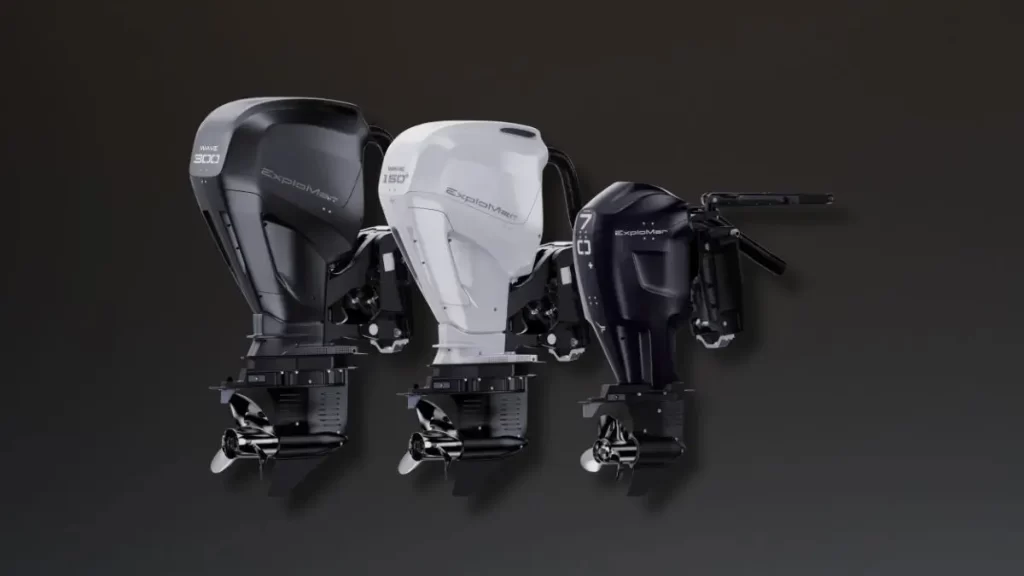
| ExploMar | WAVE 300 | WAVE 150+ | WAVE 70+ |
| Peak Power | 300hp/225kW (60s) | 200hp/150kW (60s) | 80kW (60s) |
| Continuous power | 150kW | 100kW | 40kW |
Several technical constraints determine how long an electric outboard can operate at peak power.
Thermal limits
Electric motors, inverters, and power electronics all generate heat during operation. When operating at maximum power, heat builds up rapidly. If temperatures exceed safe levels, electronic protection systems will reduce power output to prevent damage.
This is why peak power is typically limited to seconds or a few minutes, depending on system design and cooling efficiency.
Battery discharge limits
Batteries are also subject to discharge limitations. Delivering very high currents over extended periods can stress battery cells, reduce lifespan, and generate additional heat.
Controller protection systems
Modern electric propulsion systems rely on sophisticated electronic controllers. These systems monitor parameters such as: temperature, voltage, current, motor load.
In practical boating applications, peak power and continuous power serve different roles depending on how the vessel is used.
For recreational boating, peak power is most valuable in short, dynamic scenarios such as accelerating onto plane, navigating through strong currents, executing quick throttle bursts, or making precise docking adjustments. These brief but demanding moments benefit from strong instantaneous output, improving responsiveness and overall handling. However, during most leisure cruising, vessels operate at moderate speeds, where continuous power becomes the primary factor influencing efficiency and ride quality.
In contrast, for commercial and professional applications, continuous power is critical. Vessels such as fishing boats, patrol boats, workboats, and ferries operate for extended periods under steady load conditions. In these scenarios, propulsion systems must deliver stable, sustained power output to ensure operational reliability. A system with high peak power but limited continuous capability may not meet the demands of long-duration operations.
This is especially true for workboats, which often operate in challenging environments and carry heavy loads. Their propulsion systems must provide consistent thrust over long hours, making continuous power a key determinant of performance. It directly impacts sustainable cruising speed, the ability to handle currents and waves, overall operational efficiency over long routes, and reliability during extended missions.
Ultimately, while peak power defines short-term performance, continuous power defines real-world usability and endurance—particularly in demanding marine operations.
ExploMar electric outboard systems achieve both high peak power and stable continuous output through a combination of system-level engineering and extensive real-world validation. From a design perspective, the adoption of axial flux motor architecture enables significantly higher torque density within a more compact and lightweight form factor, allowing for rapid power delivery, strong low-end thrust, and superior planing performance. To address one of the key limiting factors—heat—ExploMar integrates a closed-loop cooling system optimized for marine environments, alongside dual thermal management for the battery system, ensuring thermal stability under high loads and extending the duration of peak performance.
On the energy side, a high-voltage platform supports 1–2C discharge capability, while an advanced Battery Management System (BMS) precisely regulates power output to balance performance, safety, and longevity. Complementing this, the SmartCaptain intelligent control system continuously monitors temperature, voltage, current, and motor load in real time, dynamically adjusting output to protect critical components while maintaining smooth and consistent performance.
Crucially, these capabilities are not only engineered but also proven. Through long-term, multi-scenario on-water testing, ExploMar continuously validates and refines system performance, ensuring that both peak power delivery and sustained output remain reliable under real-world marine conditions.
When comparing electric outboard motors, it is important to look beyond marketing numbers and evaluate several key parameters.
This should be the primary metric when evaluating sustained performance.
Manufacturers should indicate how long peak power can be maintained before thermal protection activates.
The battery must be capable of delivering sufficient current to support both peak and continuous power requirements.
Advanced cooling systems allow motors to maintain higher continuous power levels without overheating.
Efficient propulsion systems convert more electrical energy into usable thrust, improving range and overall performance.
By considering these factors, buyers can make more informed decisions when selecting an electric propulsion system.